


As we all prepare for the Great Lent, you might want to take a look at Fr Aidan Kimel's beautiful set of meditations on T.S. Eliot's Four Quartets.
Professor Richard Schneider has said in his classes that "Poetry is Theology par-excellence" and Fr Aidan beautifully explores the poetry of the Four Quartets in light of an Orthodox Hermeneutic...the hermeneutic lens of Pascha. What better way to begin our Lenten journey than with the song of pascha in our heart? How wonderful it is to be reminded of the rhythm, meter and movements of the Great Lent being spoken and lived as the poem of Love Incarnate.
Forgive me a sinner.
You can read the first post at http://afkimel.wordpress.com/2014/02/09/meditating-the-four-quartets/
The meditations have also be reblogged in their entirety below:
+++
 I find lyric poetry difficult, and the more modern, the more difficult. I do not know why. I was an English major. I took several poetry classes. My heart is more poetic than philosophical. Yet I can read and re-read a poem, whether by Keats or Yeats, and be completely unmoved and incomprehending. Sigh.
+++
 I still do not know who or what “they” are. The pool is empty, yet the sunlight transfigures the pool as filled with water. Lotus flowers (Buddhist symbol of enlightenment?) rise to the surface. “They” stand behind us, reflected in the pool. But reflections never show things as they really are. There is always distortion. But a cloud blocks the sun, and the vision is lost. Barrenness once again revealed.
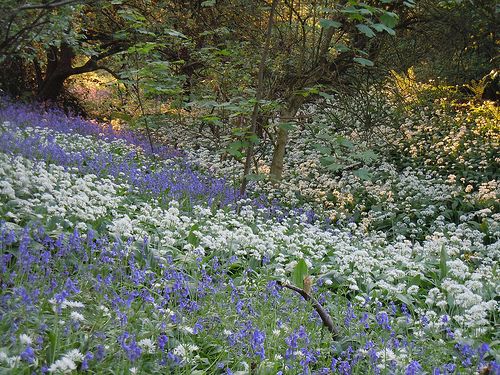 “Garlic and sapphires in the mud.” I thought immediately of wild garlic, no doubt growing throughout the unattended garden of Burnt Norton. But sapphires? Clearly Eliot wishes us to think of the beautiful blue gemstone. What brought sapphires to his mind? I did a Google search for wild garlic and found images of garlic, with white flowers, alongside bluebells. Garlic and sapphires—it’s a curious, unexpected combination. But so is everything.

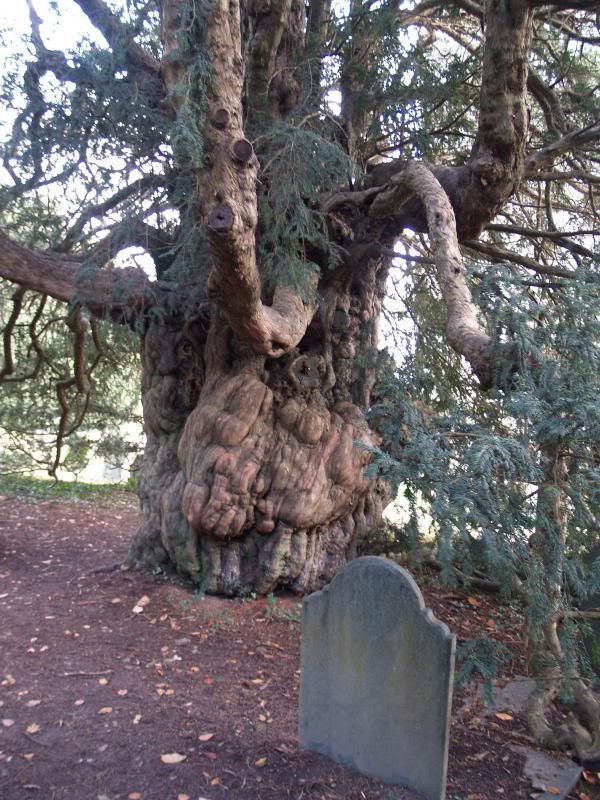 We are in a church graveyard. British graveyards, so I read, are populated with yew trees. In 1656 an Anglican vicar wrote: “Our forefathers were particularly careful in preserving churchyard Yews which by reason of their perpetual verdure were emblematical … of the immortality of the soul.” Before the Christian era yew trees were planted near pagan temple sites. They are particularly long-lived, often surviving for hundreds of years. The trees appear to thrive on corpses. I wonder if there were yew trees in the Old Forest.
 Perhaps the artist—poet, musician, potter, painter—can best express the mystery of time and eternity. Perhaps especially the poet and his words. But not words alone. Words must be shaped and brought into syntactical relationship with each other to communicate meaning. The poet is no mere wordsmith. He creates a concrete linguistic form that is itself the meaning of his utterance, just as a composer brings together sounds that become a symphony played on a Friday evening in Carnegie Hall. The poem once spoken (and poems are meant to be spoken, for how else can one hear the music of the words) seek the silence of eternity, seek to become a Chinese jar—action frozen yet always in movement. Do not call it fixity.

Perhaps I am totally misreading the poem, but let me offer this tentative suggestion—Satan. Satan is the tempter in the desert; Satan is the one who sought to undermine the ministry of Messias; Satan is the one who entered into Judas and engineered the condemnation and crucifixion of the Son of God. The poet immediately take us from the desert to the consummation of Christ’s word-making on the cross. Why is Satan lamenting? Because the very death he so meticulously arranged has become his fatal undoing. St Gregory of Nyssa puts it imaginatively thusly:
Professor Richard Schneider has said in his classes that "Poetry is Theology par-excellence" and Fr Aidan beautifully explores the poetry of the Four Quartets in light of an Orthodox Hermeneutic...the hermeneutic lens of Pascha. What better way to begin our Lenten journey than with the song of pascha in our heart? How wonderful it is to be reminded of the rhythm, meter and movements of the Great Lent being spoken and lived as the poem of Love Incarnate.
Forgive me a sinner.
You can read the first post at http://afkimel.wordpress.com/2014/02/09/meditating-the-four-quartets/
The meditations have also be reblogged in their entirety below:
+++
Meditating the Four Quartets
I find lyric poetry difficult, and the more modern, the more difficult. I do not know why. I was an English major. I took several poetry classes. My heart is more poetic than philosophical. Yet I can read and re-read a poem, whether by Keats or Yeats, and be completely unmoved and incomprehending. Sigh.
I have long wanted to read, and understand, The Four Quartets by T. S. Eliot. I have made a couple of attempts in the past, but to no success. A couple of weeks ago my wife and I listened to these four poems as read by Jeremy Irons. Splendid, absolutely splendid. I do not know how much I really understood with my mind, but my heart heard the music and rhythm of the language and embraced the imagery. At the end I was still incapable of stating the meaning of the poems (but what is the meaning of a poem but the poem itself?); but I was edified nonetheless.
In the weeks and months ahead I plan to share with you my meditations on these poems. I do not know the precise form these meditations will take. I expect that they will be a kind of stream of consciousness response—more personal impression perhaps than intellectual reflection. I do not know if they will be of any interest to anyone.
Everyone needs a guide when reading Eliot. Alongside the Quartets, I will be referring toMeditating on Four Quartets by John Booty and Dove Descending by Thomas Howard. I’ve owned the former since it was first published in 2003. I purchased the latter a few years ago. Both have just been sitting on my bookshelf, waiting for the right time to be read. Now is that time.
In music a quartet is a composition scored for four instruments. Howard suggests that the instruments in Elliot’s poems are the ancient Four Elements—Air, Earth, Water, and Fire. I did not pick up on this during Irons’s reading. We’ll just have to wait and see if Howard’s suggestion illuminates the text.
The title for each poem identifies a specific place: Burnt Norton, a ruined 17th century manor house in Gloustershire; East Coker, the village in Somerset to which Elliot traced his ancestry; the Dry Salvages, a small group of rocks off Eastern Point in Gloucester, Massachusetts; Little Gidding, an Anglican religious community established in 1626 by Nicholas Ferrar.
The Quartets are meant to be read in order. Each poem is broken into five movements. I hope to blog on each movement, one at a time. Perhaps you would like to read the Four Quartets along with me. Perhaps you are already well acquainted with them. In either case, please share your thoughts and feelings about the poems. God knows, I need all the help I can get!
Meditating Four Quartets: Burnt Norton (I)
Time present and time past / Are both perhaps present in time future / And time future contained in time past.
I live in time, bracketed by a past I can neither change nor retrieve and a future that beckons, disappoints, and terrifies. I am never satisfied with the present, never content. I am torn apart in time by time, fragmented.
Years ago I read Jean Pierre de Caussade’s The Sacrament of the Present Moment. The secret to holiness and contentment, he writes, is abandonment to the divine will given in the present moment: “To find contentment in the present moment is to relish and adore the divine will in the succession of all the things to be done and suffered which make up the duty to the present moment.” I can see the logic, but only rarely have I been able to practice such deep surrender, and even then it was never surrender. After all these years as a Christian believer and priest, I remain an ascetical failure. How odd, ironic, to find myself in the Orthodox Church. I am not drawn to Mt Athos.
What does Eliot mean when he writes that the past and present are present in the future, the future contained in the past?
Eliot was an Anglo-Catholic churchman who attended Mass faithfully. I wonder if the Mass he knew was similar to the Solemn High Mass I knew at St Paul’s Church, K Street, back in the mid-70s—a liturgy filled with chant, incense, and the beauty of holiness. In the eucharistic sacrifice, past, present, and future are reconciled and made whole. The Lamb slain before the foundation of the world gives himself to his people in his Body and Blood. The Kingdom of God is made present. The union of past and future in the present is powerfully expressed in the Liturgy of St John Chrysostom:
Remembering, therefore, this command of the Savior, and all that came to pass for our sake, the cross, the tomb, the resurrection on the third day, the ascension into heaven, the enthronement at the right hand of the Father, and the second, glorious coming.
The Church commemorates the sacrifice of Calvary and remembers the return of Christ in glory.
If all time is eternally present / All time is unredeemable.
Unredeemable time. Perhaps this is my greatest fear—that the gospel will prove false, and my life, my time becomes unredeemable.
I think of my son Aaron. He reached a point in his life when he could see no future. Time for him had become unredeemable, a frozen block of ice that could not be melted, would not be melted. When time is unredeemable, there is only hopelessness and despair.
I miss Aaron grievously. The tormenting questions remain. What could I have said or done differently? How could I have missed the signs? Suicide condemns the bereaved to the frozen, inalterable past.
In the ninth circle of the Inferno Dante pictures Satan and his fellow reprobate as frozen in ice. Is this what it means for all time to be “eternally present”? Past and future collapse into an immutable present.
Only God can redeem time and rhyme past and future.
What might have been is an abstraction / Remaining a perpetual possibility / Only in a world of speculation. / What might have been and what has been / Point to one end, which is always present.
It is so easy to live in regret, to be overwhelmed and possessed by regret, to be obsessed by “what might have been.” If only I had made different choices; if only I had spoken different words or not spoken any words; if only I had been more decisive; if only had I been more patient. So many wrong decisions. So many losses. So many failures and sins. So many people hurt. So many disappointments. So much suffering. And now the future which once seemed so full of possibilities constricts into an eternal present. How different this perditional present is from the sacrament of the present moment.
Footfalls echo in the memory / Down the passage which we did not take / Towards the door we never opened /Into the rose-garden. My words echo / Thus, in your mind. But to what purpose / Disturbing the dust on a bowl of rose-leaves / I do not know.
Haunting lines. The poet invites me into the rose-garden—or what was once a rose-garden.Thomas Howard suggests that the rose-garden may intimate Eden. I recall this citation from one of Tolkien’s letters: “We all long for Eden, and we are constantly glimpsing it: our whole nature at its best and least corrupted, its gentlest and most human, is still soaked with the sense of exile.”
But Eliot may be suggesting something else. Our memory of the garden is distorted, false. We walk down the passage we did not take. We walk through the door we never opened. Our lives are governed by regret and delusion, by a past that we have invented. And so the poet announces that by his words he intends to disturb the potpourri of rose-petals. Their scent permeates my consciousness. But they are dead. What false-past will Eliot’s words reveal to me, if I follow him into my garden?
Other echoes / Inhabit the garden. Shall we follow? / Quick, said the bird, find them, find them, / Round the corner. Through the first gate, / Into our first world, shall we follow / The deception of the thrush? Into our first world. / There they were, dignified, invisible, / Moving without pressure, over the dead leaves, / In the autumn heat, through the vibrant air, / And the bird called, in response to / The unheard music hidden in the shrubbery, / And the unseen eyebeam crossed, for the roses / Had the look of flowers that are looked at.
http://www.youtube.com/watch?v=s2N9BN-mYrw
The thrush sings to me. “Find them, find them.” Find who? what? What is the first world? Eden? My childhood? I read the lines quickly. The poet tells me that the birdsong is deceptive. Is this the danger of nostalgia, nostalgia for a past constituted by false memory? Nostalgia is seductive, as the singing of the thrush.
There they were as our guests, accepted and accepting. / So we moved, and they, in a formal pattern,/ Along the empty alley, into the box circle, / To look down into the drained pool. / Dry the pool, dry concrete, brown edged, / And the pool was filled with water out of sunlight, / And the lotos rose, quietly, quietly, / The surface glittered out of heart of light, / And they were behind us, reflected in the pool. / Then a cloud passed, and the pool was empty.
I still do not know who or what “they” are. The pool is empty, yet the sunlight transfigures the pool as filled with water. Lotus flowers (Buddhist symbol of enlightenment?) rise to the surface. “They” stand behind us, reflected in the pool. But reflections never show things as they really are. There is always distortion. But a cloud blocks the sun, and the vision is lost. Barrenness once again revealed.
The poet has invited us on a journey to find the truth of our existence.
Go, said the bird, for the leaves were full of children, / Hidden excitedly, containing laughter. / Go, go, go, said the bird: human kind / Cannot bear very much reality.
And now the very bird that has seductively enticed us into the garden cries out a warning. The thrush is right. I cannot bear to see my life as it really is. I cannot bear to know my life as death. The pond is dry, so dry. It’s all a burnt-down ruin. The spirits of the dead stand around me, watching, haunting.
Have I ever made a true confession, spoken my sins without distortion? Is the past too horrible to remember as it really was, and so I have to soften it, alter it, romanticize it? I resist the truth, resist it with all of my being. My defenses are wide and high and deep. But what do I fear?
“God,” wrote Rudolf Bultmann, “is the the insecurity of the future.” Is it God I fear? I am Adam who hides in the bracken, ashamed for my nakedness. My life is overwhelmed by fragmentation. My time is broken. I cannot make myself whole. “All the king’s horses and all the king’s men / Couldn’t put Humpty together again.”
Time past and time future / What might have been and what has been / Point to one end, which is always present.
Christ is my end, the future who is present in every moment. Only he can heal the divisions of time.
+++
Meditating Four Quartets: Burnt Norton (II)
Garlic and sapphires in the mud / Clot the bedded axle-tree.
I am no longer in the garden; but the scent of roses lingers on. The poet now presents me with a number of indecipherable images.
“Garlic and sapphires in the mud.” I thought immediately of wild garlic, no doubt growing throughout the unattended garden of Burnt Norton. But sapphires? Clearly Eliot wishes us to think of the beautiful blue gemstone. What brought sapphires to his mind? I did a Google search for wild garlic and found images of garlic, with white flowers, alongside bluebells. Garlic and sapphires—it’s a curious, unexpected combination. But so is everything.
“Clot the bedded axle-tree.” I had to do yet another Google search (I suspect I will be doing many such searches during my reading of the Quartets). “Axle-tree” denominates the wooden axis of chariots and coaches. Are we to think of a vehicle that has sunk into the mud, right up to the axle, or are we to think of the axle by itself? Is it just laying in the mud or is it standing straight up, like a tree?
Does Eliot intend the axle-tree as a symbol of the Cross? Given that the axle-tree is the crossbeam about which the wheels of the chariot or coach revolve, perhaps we may not unreasonably think of the crossbeam upon which Christ hung for the sins of mankind: “Who his own self bare our sins in his own body on the tree” (1 Peter 2:24). The Crucified God is the center around which the universe revolves.
But the Christian interpretation feels a tad strained. Perhaps we are just to think of ourselves as stuck in the confusing, contradictory muck of life.
The trilling wire in the blood / Sings below inveterate scars / Appeasing long forgotten wars.
My thought runs to the addictive British TV crime drama “Wire in the Blood.” In this show the protagonist, Dr Tony Hill, taps into his own darkness in order to sympathetically understand the pathology of serial killers. Robson Green, the actor who plays Hill, proposes that the phrase “wire in the blood” suggests a genetic kink, something impure and unusual in the blood, that creates pathological murderers. Val McDermid, the author of the Tony Hill series, comments: “Who knows what Eliot really meant by that line? Robson’s explanation is as good as any … For myself, I’ve always taken it to be a metaphor for the thrill of adrenaline surging through the bloodstream. But we’ll never know for sure.”
Like everyone else, I have been injured, damaged, marred by the wars of life, whether forgotten or not. The wounds may scar over but they do not heal. Memories clamor for obsessive attention. I am a psychologist’s dream-client. Decades later I still dwell upon the injuries, losses, and griefs, failures and sins of my life. In a perverse way they energize me. I seem unable to heal the wounds, no matter how many hours I pray, no many how many times I partake of the sacred Body and Blood, no matter how many sessions of psychotherapy I endure. All I can do is appease the voices of the past, “the trilling wire in the blood.”
The dance along the artery / The circulation of the lymph / Are figured in the drift of stars / Ascend to summer in the tree / We move above the moving tree / In light upon the figured leaf / And hear upon the sodden floor / Below, the boarhound and the boar / Pursue their pattern as before / But reconciled among the stars.
The poet introduces the image of the dance for the first time. This figure will become increasingly important in the Quartets. The dance is manifested throughout creation—in the human body’s lymphatic system, in the movement of the stars, in the royal hunt for the boar. When I think of dance, I think of the formalized grace of the waltz.
http://www.youtube.com/watch?v=55bXYnmcpC4
“The celestial song composed the universe into melodious order,” writes Clement of Alexandria, “and tuned the discord of the elements to harmonious arrangement, so that the whole world might become harmony” (Prot. 1). Every being participates in the universal choreography of the cosmos.
The poet glimpses in the various dances of creation a reconciliation of contraries, a reconciliation that occurs at the still point where eternity and time meet.
At the still point of the turning world. Neither flesh nor fleshless; / Neither from nor towards; at the still point, there the dance is, / But neither arrest nor movement. And do not call it fixity, / Where past and future are gathered. Neither movement from nor towards, / Neither ascent nor decline. Except for the point, the still point, / There would be no dance, and there is only the dance. I can only say, there we have been: but I cannot say where. And I cannot say, how long, for that is to place it in time.
I adore these lines. I speak them aloud over and over again. Eliot draws us through the dances of the world into the eternity that sources the dances. We call it the still point, but it is a stillness that transcends both inactivity and movement, for it is dance itself, the perichoretic communion of the Father, Son and Spirit who is the wellspring of all created dances. Eliot does not explicitly identify the still point as the Holy Trinity, but surely the Christian reader may take this liberty. The Triune God is not a static thing but, as C. S. Lewis expresses it, “a dynamic, pulsating activity, a life, almost a kind of drama. Almost, if you will not think me irreverent, a kind of dance.” And there is only the dance, the dance that transcends ascent and descent and all movement. Thomas Howard elaborates on the Eliotean still point:
“At the still point of the turning world.” We have all been told by the mathematicians and physicists that there is an unmoving point at the exact center of any wheel, or axle, that is not moving. The whole thing movesaround that point. So. The world, in the sense of this globe upon which we find ourselves, and the world in the sense of the totality of human experience, has at its center that point around which it turns. The point is still. It is “neither flesh nor fleshless”: that is, we are not excluding either the physical world (which most of us suppose, in our lesser moments, to be the “real” world) or the nonphysical, that is, the world of spirit, or of theory, or of fancy. And “from” and “toward” won’t help us, since they belong to the world of measurement, or geography. No. It is the still point around which the entire dance (Eliot does not capitalize it yet) moves. In a highly compressed sense, it is the dance, since from it emanate all the movements there are. It is not itself movement: but “arrest” or “fixity” won’t do, since these words imply—well, just that: arrest or fixity. But this is a vibrant point, the wellspring of all movement. And it is here that past and future are gathered. (Dove Descending, pp. 44-45)
There is only the dance.
The inner freedom from the practical desire, / The release from action and suffering, release from the inner / And the outer compulsion, yet surrounded / By a grace of sense, a white light still and moving, / Erhebung [elevation, exaltation] without motion, concentration / Without elimination, both a new world / And the old made explicit, understood / In the completion of its partial ecstasy, / The resolution of its partial horror.
Eliot here describes the spiritual state that characterize the saints who have experiencedtheosis—freedom from all compulsion, awareness of the divine light and the world redeemed and made new, the integration of personhood within the still point of the eternal dance.
I have only experienced the still point a few times in my life. United to my beloved, looking deep into her eyes, into the depths of eternity. In those rare and precious moments I rested, and the words of the psalmist were fulfilled: “Be still, and know that I am God” (Ps 46:10).
But the purification of soul of which the ascetics speak remains a goal beyond my desire, though life itself brings its own measure of suffering and privation.
Yet the enchainment of past and future / Woven in the weakness of the changing body, / Protects mankind from heaven and damnation / Which flesh cannot endure.
Howard suggests that these four lines might well “serve to crown the whole of theQuartets” (p. 47). We are imprisoned in time, yet it is precisely our temporality, the fact that we live in journey, that protects us from both the beatific and infernal visions. We are prepared for neither. “The point is,” Howard explains, “we cannot ‘endure’ these titanic ultimacies. We are ready for neither yet, and we may give fervent thanks for the limitations that belong to our flesh, since if Reality (either heaven or damnation) were suddenly to loom upon us, we would be destroyed altogether. Our true and proper way liesvia time and the flesh, not by a flight from them, as the Gnostics and transcendentalists and Platonists would have it” (p. 48). Humankind, as the poet told us in the first movement, can only bear limited revelations of the truth. Ours is the way of purgation and continuous transformation.
Time past and time future / Allow but a little consciousness. / To be conscious is not to be in time / But only in time can the moment in the rose-garden, / The moment in the arbour where the rain beat, / The moment in the draughty church at smokefall / Be remembered; involved with past and future. Only through time time is conquered.
“The only reason for time,” remarked Albert Einstein, “is so that everything doesn’t happen at once.” Our experience of existence is fleeting and episodic. We are not conscious of the whole but only as it presents itself to us, one moment at a time. Only God is fully conscious. (I need to re-read Book XI of St Augustine’s Confessions.) Only as we exist in time can we experience the revelations of existence. Yet each revelation, once received, now exists only in memory. What are memories?
http://www.youtube.com/watch?v=ZTzA_xesrL8
There is only the dance … the dance of life, the dance of eternity, the dance of the Holy Trinity.
+++
Meditating Four Quartets: Burnt Norton (III)
Between the title of the poem and the first line of poety, Eliot has inserted two quotations from the ancient philosopher Heraclitus: οῦ λόγου δὲ ἐόντος ξυνοῦ ζώουσιν οἱ πολλοί ὡς ἰδίαν ἔχοντες φρόνησιν (“although Reason is common to all, most people live as though they had wisdom of their own”) and ὁδὸς ἄνω κάτω μία καὶ ὡυτή (“the way up and the way down are one and the same”). The significance of the epigraph emerges in the third movement of “Burnt Norton.”
Here is a place of disaffection / Time before and time after / In a dim light: neither daylight / Investing form with lucid stillness / Turning shadow into transient beauty / With slow rotation suggesting permanence / Nor darkness to purify the soul / Emptying the sensual with deprivation / Cleansing affection from the temporal.
We are in Eliotean wasteland now. A place of flickering twilight, imprisoned in the monotony of sequential time, deprived of both the brightness of day, which might reveal the transient beauties of the world, and the opaqueness of night, which might provide the purification necessary for the soul.
Neither plenitude nor vacancy. Only a flicker / Over the strained time-ridden faces / Distracted from distraction by distraction / Filled with fancies and empty of meaning / Tumid apathy with no concentration / Men and bits of paper, whirled by the cold wind / That blows before and after time, / Wind in and out of unwholesome lungs / Time before and time after. / Eructation of unhealthy souls / Into the faded air, the torpid / Driven on the wind that sweeps the gloomy hills of London, / Hampstead and Clerkenwell, Campden and Putney, Highgate, Primrose and Ludgate. Not here / Not here the darkness, in this twittering world.
We are in the gloam of the London Underground amidst the walking dead. Are we descending in the elevator? standing on the platform? sitting on the train? It doesn’t matter. Everywhere we look we see the diseased and torpid, swollen in their creeping damnation. Does the poet count himself among these hollow souls? I do not know, but I do not hear contempt in his words, only diagnosis. This is who we are—thoughtless, superficial, sick, constantly texting on our cell phones, purblindlessly traveling the human subway.
This is who I am—twittering and blogging, blogging and twittering, with an occasional email exchange with my wife. When one is “religious,” it’s easy to think that one is living at a deeper level than others. The truth is that we too often use our faith to hide from the sin that grips our hearts and degrades our lives. We do not even notice our foul breath and periodic eructation.
After Aaron died I found that I could hardly bear to be around other people. I have no patience for easy words of cheap consolation. I had never known this intensity of grief. I was devastated beyond words. Aaron’s death did not move me into a mode of spiritual doubt—that had occurred only a few years earlier. Doubt has always been a powerful dimension of my spiritual life, yet I did not find myself confronting God in anger and accusation. The anger and accusation have been directed solely towards myself and the psychologist to whom I entrusted Aaron’s care. What might I have done to save my son? How could the counselor have not seen the signs?
I have been profoundly changed, though others may not perceive the difference. I suspect that the homily I preached at Aaron’s funeral will be my last. I have no wisdom to offer. I crave silence … yet not too much silence. I still need the noise to protect me from the sorrow. Humankind cannot bear very much reality.
Descend lower, descend only / Into the world of perpetual solitude, / World not world, but that which is not world, / Internal darkness, deprivation / And destitution of all property, / Desiccation of the world of sense, / Evacuation of the world of fancy, / Inoperancy of the world of spirit; / This is the one way, and the other / Is the same, not in movement / But abstention from movement; while the world moves / In appetency, on its metalled ways / Of time past and time future.
There is only one way to proceed—descent into solitude and dispossession, into the darkness that is liberation. We must go deeper than the London Underground if we would encounter Reality. One need not retreat to the desert. Life imposes its own asceticism. But one must find a way, by faith, to suffer the suffering and live through the loss and endure the darkness. For the past year and a half the Jesus Prayer has been my constant companion: “Lord Jesus Christ, Son of God, have mercy upon me, a sinner.” Often it is the only prayer I can utter. There have been no illuminations and few consolations.
I do not know if this darkness is akin to the night of the senses, of which St John of the Cross speaks.
John Booty elaborates the Eliotean vision of spiritual transformation:
This is a twilight kingdom, wholly self-contained, a “twittering world” in which there is no awareness of darkness, especially not of the darkness through which we grope to attain salvation. Or so it seems. But now we are made suddenly aware that the way up is the way down; the way toward the “still point” of the world is through this twilight kingdom. We must, the poet says, descend as the escalator descends, as the lift descends at the Gloucester Road Underground Station, descend into “the world of perpetual solitude.” The challenge now is to accept existence in time and to be submerged in time, going down, going ever lower, as indicated by Heraclitus and as described, with directions, by St. John of the Cross. The way up is the way down, the gradual descent into utter darkness, in three discernible stages: negation or desiccation first of the senses, then of fancy or intellect, and finally of the spirit as well. This is the deliberate descent into darkness whereby the light, the heart of light at the still point where the dance is, may be perceived. Here is the first glimpse in these poems of the mystic way of ascent to beatitude by means of descent into darkness—the negative way. (Meditating on Four Quartets, p. 13)
Mine has always been a wintry spirituality (despite Cursillo, despite my “baptism in the Spirit”). I wish it were not so. I envy those who feel the warmth of the Spirit and walk with Jesus as their companion. But may not the experience of God’s absence be an experience of God, of the One who infinitely transcends all and is present at the heart of all things? God is not an object within the sensible world. But how does one distinguish Absence from Nothingness? Is there a difference? Nothingness, I propose, elicits apathy or despair; absence elicits lament: “Even the cry from the depths is an affirmation,” Martin Martywisely states. “Why cry if there is no hint or hope of hearing?”
Tragedy is not salvation. I still live in “appetency” (this time I did not have to check my dictionary to figure out the meaning of the word). I cannot evade the purgative way and the struggle with the passions (“Cleansing affection from the temporal”), yet my record is principally one of failure. Neither books on the spiritual life nor the counsel of spiritual directors have never been of much help to me, as I seem incapable of implementing the recommended disciplines. In seminary no one in our class missed more of the Divine Offices than I. Thirty-years later I remain that same man. I would surely flunk out of Mt Athos. Kyrie eleison.
I must recite one of my favorite poems:
Batter my heart, three person’d God; for, you
As yet but knocke, breathe, shine, and seeke to mend;
That I may rise, and stand, o’erthrow mee,’and bend
Your force, to breake, blowe, burn and make me new.
I, like an usurpt towne, to’another due,
Labour to’admit you, but Oh, to no end,
Reason your viceroy in mee, mee should defend,
But is captiv’d, and proves weake or untrue.
Yet dearely’I love you,’and would be loved faine,
But am betroth’d unto your enemie:
Divorce mee,’untie, or breake that knot againe;
Take mee to you, imprison mee, for I
Except you’enthrall mee, never shall be free,
Nor ever chast, except you ravish mee.
Thus my Augustinian hope.
O Lord, bring me to the still point of the turning world.
+++
Meditating Four Quartets: Burnt Norton (IV)
Time and the bell have buried the day,
The black cloud carries the sun away.
Will the sunflower turn to us, will the clematis
Stray down, bend to us; tendril and spray
Clutch and cling?
Chill
Fingers of yew be curled
Down on us? After the kingfisher’s wing
Has answered light to light, and is silent, the light is still
At the still point of the turning world.
Dusk. Vespers has rung. Evening is deepening. The poet wonders whether the sunflowers and clematis will now turn to human beings for light and warmth. But suddenly the lyric turns frightening. The flora begins to grasp him, to clutch at him and cling to him. Any number of horror movies come to mind. Nature seeks out life in order to survive. In the darkness humanity becomes food for the dying world.
We are in a church graveyard. British graveyards, so I read, are populated with yew trees. In 1656 an Anglican vicar wrote: “Our forefathers were particularly careful in preserving churchyard Yews which by reason of their perpetual verdure were emblematical … of the immortality of the soul.” Before the Christian era yew trees were planted near pagan temple sites. They are particularly long-lived, often surviving for hundreds of years. The trees appear to thrive on corpses. I wonder if there were yew trees in the Old Forest.
The poet’s imagination sinks deep into the ground—the roots and tendrils of the yew are curling around him, strangling him, sucking out his life, extending its life by absorbing his own. Deeper into the darkness.
And then a kingfisher, with its beautiful plumage, catches his eye.
http://www.youtube.com/watch?v=nU-TRdWd1jU
A flash of light reflects off its wing. In that moment the poet is drawn into the divine peace. At the heart of the darkness, with all of its terrors, is the brilliant luminescence of eternity.
“And the light shineth in darkness; and the darkness comprehended it not” (Jn 1:5).
+++
Meditating Four Quartets: Burnt Norton (V)
Words move, music moves / Only in time; but that which is only living / Can only die. Words, after speech, reach / Into the silence. Only by the form, the pattern, / Can words or music reach / The stillness, as a Chinese jar still / Moves perpetually in its stillness.
Perhaps the artist—poet, musician, potter, painter—can best express the mystery of time and eternity. Perhaps especially the poet and his words. But not words alone. Words must be shaped and brought into syntactical relationship with each other to communicate meaning. The poet is no mere wordsmith. He creates a concrete linguistic form that is itself the meaning of his utterance, just as a composer brings together sounds that become a symphony played on a Friday evening in Carnegie Hall. The poem once spoken (and poems are meant to be spoken, for how else can one hear the music of the words) seek the silence of eternity, seek to become a Chinese jar—action frozen yet always in movement. Do not call it fixity.Not the stillness of the violin, while the note lasts, / Not that only, but the co-existence, / Or say that the end precedes the beginning, / And the end and the beginning were always there / Before the beginning and after the end. / And all is always now.
Eliot returns to the meditation of the first movement on the mystery of past, present, and future. Think of that moment when the violinist lifts his bow from the strings, yet the last note continues. Stillness and music together. But that image does not quite seem to capture what Eliot is straining to express. The making of the music is behind us, even though the sound briefly continues. Past, present, and future remain unreconciled. Perhaps “coexistence” signifies what Eliot wants to say; but no, that doesn’t quite work either. The prefix “co-” simply brings two different things together into the same place, as it were. Unhappy husband and wife might co-exist under the same roof but they are hardly united. Only a poet can say what needs to be said: but what does it mean to say that the end precedes the beginning, to suggest a “before” the beginning and an end “after” the end?
Words strain, / Crack and sometimes break, under the burden, / Under the tension, slip, slide, perish, / Decay with imprecision, will not stay in place, / Will not stay still.
How can our words, words born in time, intending the movement and things of time, signify that which transcends time? How can we speak of eternity? Perhaps we might think of what it is not; but even the via negativa may mislead, as Eliot warned us in the second movement. Our language is inadequate. Our words slide, crack, and break under the weight of a task too great for them. They resist the patterning work of the speaker.
At this moment I am reading a poem that was written decades ago. Do the words mean what Eliot meant? The meanings of words are constantly changing—but not just their dictionary meanings. A sentence can be spoken in different ways. How it is spoken will change the meaning. I try to understand. I re-read the poem multiple times. I listen to Eliot’s recording. I do my best to interpret, but I cannot call the poet on the phone and ask him if my interpretation even begins to approach the meaning he intended. Like his words, the poet has passed from time into death. His historical life is complete. But our lives are ill-equipped to bespeak eternity. They crack and break under the burden.
And yet the printed words of a dead poet are generating new meanings in my life. Even if my interpretations of “Burnt Norton” are critically incorrect, are they therefore incorrect?
Shrieking voices / Scolding, mocking, or merely chattering, / Always assail them.
Whose voices? The voices of the past? The twittering voices in the London Underground? The voices of the fragmented soul? Or perhaps Eliot is thinking of literary critics who take up the compositions of poets and then subject them to minute analysis and withering critique. Eliot himself was both poet and critic. The journey towards eternity is always under threat, both from ourselves and from others.
The Word in the desert / Is most attacked by voices of temptation, / The crying shadow in the funeral dance, / The loud lament of the disconsolate chimera.
Finally Eliot introduces the One for whom we have been waiting, the One of whom all of his words have been straining to invoke. Who else can redeem time but the eternal Logos who has appropriated time?
In the beginning was the Word, and the Word was with God, and the Word was God. The same was in the beginning with God. All things were made by him; and without him was not any thing made that was made. … And the Word was made flesh, and dwelt among us, (and we beheld his glory, the glory as of the only begotten of the Father,) full of grace and truth. (Jn 1:1-3, 14)
Thinking of the manifold threats to the work of the poet in speaking his word, the poet thinks of the threats to the Word in the desert as he prepared to live out his mission in time.
The last two lines of the stanza befuddle me. Who is the crying shadow and disconsolate chimera?
Perhaps I am totally misreading the poem, but let me offer this tentative suggestion—Satan. Satan is the tempter in the desert; Satan is the one who sought to undermine the ministry of Messias; Satan is the one who entered into Judas and engineered the condemnation and crucifixion of the Son of God. The poet immediately take us from the desert to the consummation of Christ’s word-making on the cross. Why is Satan lamenting? Because the very death he so meticulously arranged has become his fatal undoing. St Gregory of Nyssa puts it imaginatively thusly:
The opposing power could not, by its nature, come into immediate contact with God’s presence and endure the unveiled sight of him. Hence it was that God, in order to make himself easily accessible to him who sought the ransom for us, veiled himself in our nature. In that way, as it is with greedy fish, he might swallow the Godhead like a fishhook along with the flesh, which was the bait. Thus, when life came to dwell with death and light shone upon darkness, their contraries might vanish away. For it is not in the nature of darkness to endure the presence of light, nor can death exist where life is active. (Orat. cat. 24)
The death of Eternity in time liberates all trapped in the turning world. The chimera who has ever sought to destroy humanity becomes a mere crying shadow.
Only the Word slain before the foundation of the world poet can compose a poem that effectively, definitively, and poetically resolves the problem of mortality and time. Pascha is this poem. The resolution cannot be violently imposed by the Creator. It must come from within, through enfleshment, through entemporalization, death, and resurrection. “Only through time time is conquered.”
The detail of the pattern is movement, / As in the figure of the ten stairs. / Desire itself is movement / Not in itself desirable; / Love is itself unmoving, / Only the cause and end of movement, / Timeless, and undesiring / Except in the aspect of time / Caught in the form of limitation / Between un-being and being.
Humanity is created for Eternity. Not an impersonal Absolute that swallows up all creaturely distinctions and identities. That would be not a reconciliation but abolition. The Eternity toward which the Quartets directs us is the One who is both utter stillness and yet source of movement and dance. He is the One of whom St Augustine could sing: “Thou hast made us for thyself, and our heart is restless until it finds its rest in thee.” All human desire, no matter how warped and distorted, ultimately seeks for the One who is humanity’s ultimate Good, the Good who transcends desire, the Good who is both cause and consummation of desire, the Good who is eternal Love within the perfect and eternal communion of the Father, Son, and Spirit.
Sudden in a shaft of sunlight / Even while the dust moves / There rises the hidden laughter / Of children in the foliage / Quick now, here, now, always— / Ridiculous the waste sad time / Stretching before and after.
We are back in the rose-garden. The words of the poet have done their work. The dust of the petals move in our consciousness. We hear the laughter of the children, perhaps our own laughter in a lifetime that no longer seems to have been our own. It can only be remembered … yet perhaps more than remembered.
